


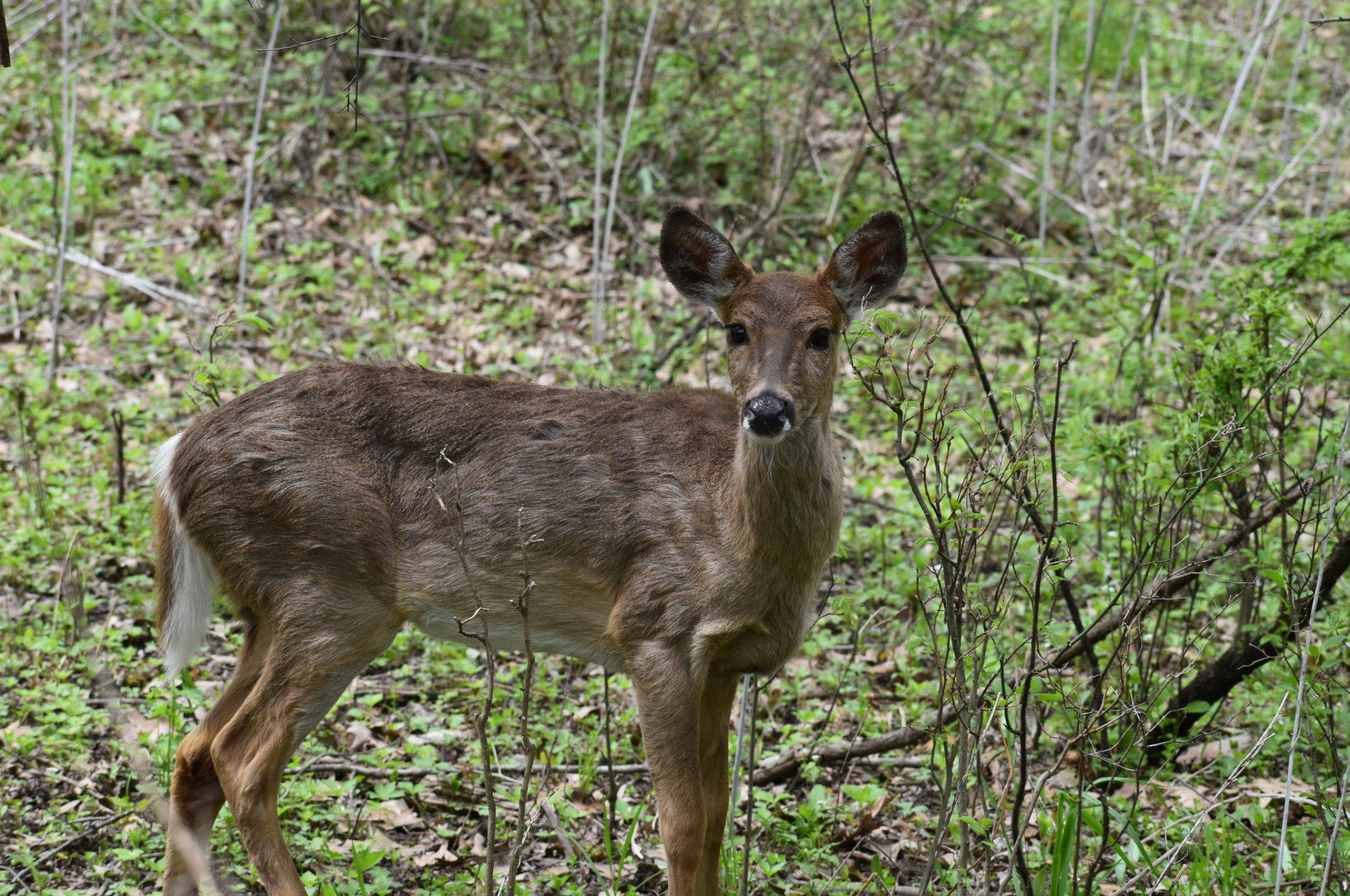
Photo: © Kyle Keenan, some rights reserved (CC-BY-NC), iNaturalist
The two most prevalent wildlife diseases impacting Illinois deer are chronic wasting disease (CWD) and epizootic hemorrhagic disease (EHD). While EHD outbreaks occur occasionally and are usually minor, CWD is a persistent disease that can have significant negative consequences for the deer population if left unmanaged. EHD is often confused with bluetongue, a disease with similar symptoms that can affect sheep and cattle. EHD and bluetongue are different diseases.
Illinois residents and hunters are encouraged to report sick or dead deer to Illinois Department of Natural Resources biologists. If you find a sick or dead deer suspected of having EHD (epizootic hemorrhagic disease), CWD (chronic wasting disease) or other diseases, please submit your sighting using this form. All sick or dead deer observations in Illinois can be viewed on the dashboard.
Lyme disease is caused by infection with the bacterium Borrelia burgdorferi. Deer can be the host for ticks, and they are an important link in the life cycle of the black-legged tick (Ixodes scapularis), also known as the deer tick. Deer, and other wild mammals, provide food for adult ticks in the form of blood meals.
Deer do not transmit the disease, but coming into contact with deer can increase the risk of exposure to ticks. Due to their mobility, deer can move attached ticks long distances before the ticks drop off to lay their eggs on the ground. The eggs develop into larva which then turn into nymphs (immature ticks).
People can become infected through the bite of a nymph infected by the bacterium. Adult ticks can also transmit the bacteria, but transmission is less common since adult ticks are more easily detected and removed prior to transmission.
Symptoms of Lyme disease include fever, headache, fatigue, and a characteristic skin rash called erythema migrans. If left untreated, infection can spread to the joints, heart, and nervous system.
Lyme disease can be treated with antibiotics if caught early. More information about Lyme disease is available from the Centers for Disease Control and Prevention.
Anaplasmosis, caused by the rickettsia Anaplasma marginale, is an important disease of cattle in North America. White-tailed deer can be carriers even if they show no signs of being infected. Research conducted at Southern Illinois University in Carbondale determined that the occurrence in deer was 0% at 6 months of age and 14% at 2½ years of age.
Bovine brucellosis—commonly called Bang’s disease—is caused by the bacterium Baucella abortus. The principal reservoirs are cattle, not deer as many people believe. Cattle are the usual victims of infection. Brucellosis causes abortion of fetuses, infertility, and reduced milk production. Repeated studies in many states, including Illinois, have shown that deer are not important in the occurrence of brucellosis.
Bovine tuberculosis is a chronic bacterial disease caused by the microorganism Mycobacterium bovis attacking the respiratory system. Primarily a disease of cattle, it can affect other species, including humans and wildlife. Once relatively common in cattle in the United States, the disease has been reduced in cattle by the APHIS Bovine TB Eradication Program.
Spillover into wildlife may maintain the microorganism in the environment and function as a source of reinfection for livestock. Prior to 1994, the disease had been reported in only eight wild white-tailed and mule deer. Active surveillance for the disease in wildlife is under way in Michigan, Minnesota, and Indiana, where the disease has been documented in white-tailed deer.
One of the first studies looking for evidence of SARS-CoV-2, the virus that causes COVID-19, in deer was conducted by the USDA Animal and Plant Health Inspection Service (APHIS) Wildlife Services program. In the study, conducted between January 2020 and March 2021, researchers analyzed a total of 481 serum samples from wild white-tailed deer in Illinois, Michigan, New York, and Pennsylvania. Results of the Wildlife Services study showed that some of the deer in those four states had been previously exposed to SARS-CoV-2. Illinois deer had the lowest exposure with 7 percent of 101 samples containing antibodies to SARS-CoV-2. In Michigan, 67 percent of 113 samples contained antibodies; in New York 19 percent of 68 samples contained antibodies; and in Pennsylvania 31 percent of 199 samples contained antibodies. APHIS wrote a short Question & Answer guide about the results of this study to highlight what is currently known and not known about transmission of COVID-19 and deer. Since that study, free-ranging white-tailed deer have also tested positive for exposure to SARS-CoV-2 in Iowa, Ohio, Oklahoma, and in Quebec, Canada.
It is not currently known how wild deer were originally exposed to SARS-CoV-2. Tracking the spread of viruses and disease through wild populations is difficult, but researchers think that the infected deer were likely exposed through multiple sources: the environment, by other animal species and by people. Once infected, and given their gregarious nature, deer likely began to spread the virus among other local individual deer.
It was noted that the deer in the Wildlife Services study did not show any clinical signs of illness. The researchers explained that the presence of antibodies was the result of the immune system response of the deer to being previously infected and did not necessarily suggest a current infection. Other research has shown that white-tailed deer are susceptible to SARS-CoV-2 infection, but in studies where captive deer have been exposed to the virus, they either did not show signs or had mild signs of illness, including coughing and raspy breathing.
There is currently no evidence that people can get COVID-19 by preparing or eating meat from a deer that is infected with SARS-CoV-2. Heat kills the virus. However, hunters should always practice good hygiene when processing animals by following these food safety recommendations from USDA Wildlife Services:
• Do not allow contact between wildlife and domestic animals, including pets and hunting dogs.
• Do not harvest animals that appear sick or are found dead.
• Keep game meat clean and cool the meat down as soon as possible after harvesting the animal.
• Avoid cutting through the backbone and spinal tissues and do not eat the brains of wildlife.
• When handling and cleaning game: Wear rubber or disposable gloves and do not eat, drink, or smoke while handling the animal.
• When finished handling and cleaning game: Wash your hands thoroughly with soap and water. Clean knives, equipment, and surfaces that were in contact with game meat with soap and water and then disinfect them.
• Cook all game meat thoroughly (to an internal temperature of 165 °F or higher).
• Check with an IDNR District Wildlife Biologist regarding any testing requirements for other diseases and for any specific instructions regarding preparing, transporting, and consuming game meat.
The results of these initial studies indicate that white-tailed deer can serve as potential reservoir hosts for SARS-CoV-2. What that will mean for the long-term persistence of the virus, or its future evolution and variants, is not yet known. Researchers believe that there has been spillover from humans to deer and there is known deer-to-deer transmission. Spillback from deer to humans may be possible but there is not yet definitive evidence. Both observational and experimental studies in free-ranging, captive, domestic, and farmed animals have shown that as of January 2022, SARS-CoV-2 has been shown to infect at least 29 non-human mammalian species.
In Illinois, more research is already under way to better understand how SARS-CoV-2 is impacting deer. Beginning in November 2021, USDA Wildlife Services collected opportunistic samples at Illinois Department of Natural Resources hunter-harvest check stations and from other sites in Illinois. This work is ongoing, and the results of that study will be shared when they become available.
Chronic Wasting Disease (CWD) was first found in Illinois in 2002 in Winnebago County. CWD poses a serious threat to deer populations in areas where it occurs.
CWD is caused by a prion protein, not a bacteria or virus, that results in neurological degeneration and death in deer. All deer, regardless of age, can carry and transmit the disease. CWD attacks the nervous system and is contagious among deer, with infection passed between deer and also from contaminated environments.
The disease is fatal to deer— there is no treatment or cure. As the disease progresses, deer display abnormal behavior, lose weight, and lose control of their normal bodily functions.
A deer with CWD usually dies within about 18 months. During this time the infected deer typically shows signs of the disease only in the last month of life.
• Loss of coordination and inability to stand
• Drooping of head and ears
• Severe emaciation and dehydration
• Excessive salivation and nasal discharge
• Walking in set patterns
• No fear of humans
• Teeth grinding
• Excessive thirst
• Difficulty swallowing
• Nervousness
• Diminished tone of facial muscles
• Excessive urination
Hunters or landowners who find sick or dead deer that they suspect may have CWD are asked to REPORT it to IDNR.
Visit the CWD Sampling page for more information about CWD in Illinois.
Epizootic hemorrhagic disease (EHD) was first identified in Illinois in the 1970s. EHD is a vector-borne viral disease of deer transmitted by insects of the genus Culicoides (often referred to as midges, gnats or “no-seeums”). EHD virus is not transmissible through direct “animal to animal” or “animal to human” contact.
EHD can affect adult deer, fawns and yearlings. Some deer become infected and die within 48 hours, while others are minimally affected. The disease is often fatal and causes fever and severe internal bleeding. Survivors of EHD infection develop immunity to the virus.
The disease does not impact deer populations evenly across the landscape, changing with local vector abundance and differences in deer immunity and infectious status. Likewise, severity of this disease can vary from year to year. The impact on deer populations is not predictable because outbreaks depend upon weather conditions that influence the size of the midge population.
Drought conditions tend to exaggerate the impacts of EHD, as deer tend to congregate around the limited water sources. Receding water levels around ponds, lakes, streams and rivers result in exposed muddy areas from which the midges hatch. Disease transmission is more likely where deer are concentrated and midges infected with the EHD virus are abundant.
Deer also are attracted to water to combat fever and dehydration. Dead and sick deer often are found near water sources such as lakes, ponds or streams, although a deer carcass found farther from a water source could have succumbed to EHD.
Flooding makes more water available for midges to breed in. This can result in increased EHD outbreaks.
There is no effective management treatment for this disease for deer. The number of infected deer will decrease after a hard frost or freezing temperatures kills the midges or gnats that transmit the disease between deer.
Hunters or landowners who find sick or dead deer that they suspect may have EHD are asked to REPORT it to IDNR.
• Appetite loss
• Loss of fear of humans
• Weakness
• Excessive salivation
• Respiratory distress
• Appearing feverish and depressed
• Pronounced swelling of head, neck, tongue, and eyelids
• Lack of consciousness
• Blue appearance of tongue and other tissues in the mouth due to hemorrhage and lack of oxygen in the blood
• Shock-like state; becoming prostrate and dying, often near water
• Possible evidence of lesions in mouth and in rumen lining
• Possible sloughing hooves (often seen in fall harvest)
Yes, it is safe to eat venison from animals that may have contracted EHD and survived.
While EHD can be fatal to deer, it is not hazardous to humans, livestock, or pets. EHD is often confused with bluetongue, a similar disease that can affect sheep and cattle. EHD and bluetongue are different diseases, but they have similar symptoms. Veterinarians treat livestock with suspected cases of bluetongue with anti-inflammatories and antibiotics to manage existing lesions and prevent secondary infections.
Domestic and wild ruminants, such as sheep, goats, cattle, buffalo, deer, elk, and antelope act as vertebrate hosts for EHD and the closely related, and similarly transmitted, bluetongue disease.
EHD is diagnosed from a blood sample or from a refrigerated sample of spleen, lung, or lymph node tissue. There are three clinical manifestations of the disease: peracute, classical (or acute), and chronic forms.
Deer have a high fever, weakness, anorexia (loss of appetite), respiratory distress, and edema (abnormal accumulation of fluids) in the head, neck, and tongue. There is a tendency for bleeding, hemorrhage resulting in bloody diarrhea and blood in the urine, and dehydration. Some deer with the peracute form die 8 to 36 hours before showing clinical signs.
Symptoms are similar to the peracute form, but the signs are accompanied by hemorrhages in the skin, heart, or gastrointestinal track; redness in the inside of eyelids and mouth; and salivation and nasal discharge that can be tinted with blood. Deer sometimes have ulcers in the tongue, palate, or rumen.
Deer with the chronic form of EHD develop ulcers and scars, along with hemorrhages on the lining of eyelids, membranes, mouth, and intestinal walls that result in weight loss, even when there is plenty of food available. Deer may have detachment of the wall of the hoof, making it hard for them to walk. In deer that recover, abnormal hoof growth may be noted. Some deer survive the chronic form.
EHD may significantly decrease the deer population in a localized area; however, the population generally recovers within a few years. Normally, impacts to county-wide deer populations are not severe and often are difficult to detect, although in significant outbreak years, such as 2012, the impacts can be more far-reaching.
A drought is not required for deer to contract EHD; however, significant outbreaks often are associated with droughts and hot temperatures. Drought conditions result in limited water, which concentrates deer in locations with remaining water. Receding water levels around ponds and lakes and along streams and rivers result in exposed muddy areas from which the midges can hatch. Disease transmission is more likely where deer are concentrated and midges infected with the EHD virus are abundant.
Cutaneous fibromas are caused by a virus that results in hairless tumors on the skin. They are common and usually temporary. Fibromas can be found anywhere on the body and vary in size from about ¼ inch to more than 8 inches in diameter. They often have a warty appearance. Transmission occurs by biting insects and possibly by direct contact with various contaminated materials that might scratch the skin. Although these fibromas are easily noticed by hunters and are considered unsightly, they are merely small blemishes and are not considered a threat to deer populations. Occasionally, massive or numerous tumors interfere with the activities of a deer, affecting its sight, respiration, breathing, or walking ability; which can lead to the death of the deer. There is no danger of deer spreading fibromas to domestic stock or other animals, and human infection has not been reported.
Ticks, louse flies, lice, ear mites, and demodectic mange are all common external pests found on white-tailed deer. However, these have little effect on the general health of the animal.
Nasal bot flies are a normally occurring parasite of deer. Larvae of the bot fly (genus Cephenemyia) normally live in pouches at the back of a deer’s throat. They are most frequently discovered by hunters after hanging a deer carcass for a period of time, as the larvae leave the passages in the head and can be found in the body cavity or on the ground under the hanging carcass. They pose no threat to human or livestock health and safety.

Photo: Michael Jeffords
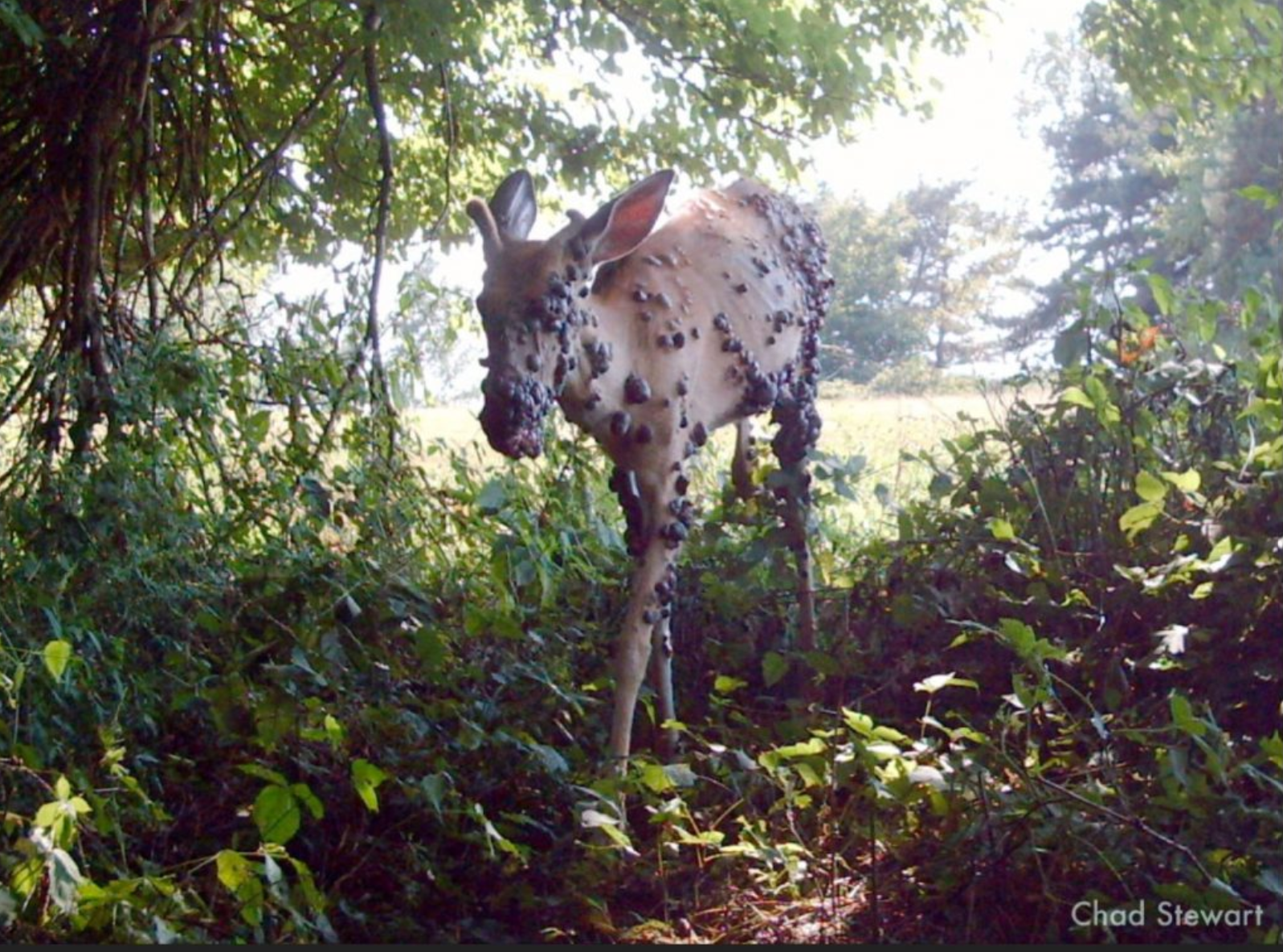
Photo: IDNR image library